The Gauges Green PDLC
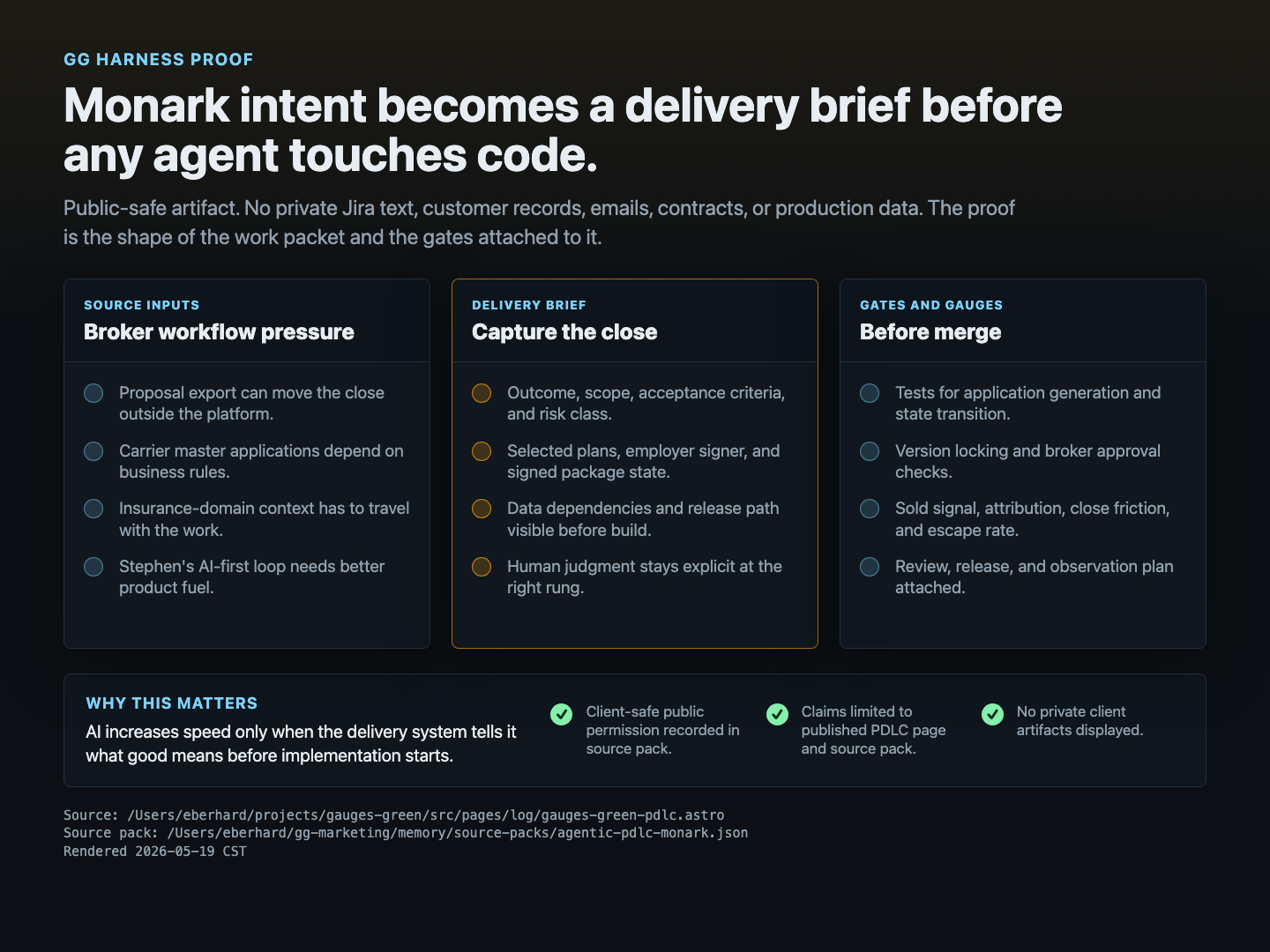
Monark is the clean example.
The visible work is product development for an insurance and benefits quoting platform. The real work is more specific: turn broker workflows, carrier requirements, business rules, Jira tickets, Notion notes, and Stephen's AI-first engineering loop into a delivery system that can move quickly without losing the plot.
That is what we mean by an agentic PDLC.
Monark already has the coding-agent instinct. The sharper question is what the product system has to know before any human or agent touches the codebase.
For Monark, that means the system needs to know how brokers close a group, where the XLSX export causes visibility to disappear, which carrier master applications need to be generated, which fields can be auto-filled, which signature event counts as a bind signal, and which revenue motion the work is supposed to support.
If that context stays informal, AI increases speed and uncertainty at the same time. If the context becomes an operating artifact, AI can increase speed and control together.
The Delivery Brief
The first strong Monark example is the Get Paid workflow.
Today, the broker can export a proposal as XLSX and continue the close outside the platform. Once that happens, Monark can lose visibility into which carrier won, whether the group bound, and whether Monark is attached to the business at submission.
A normal ticket might say "add e-signature" or "improve proposal close." That leaves too much for the assignee to reconstruct. The useful unit is a delivery brief: a compact work packet that carries the business reason, affected workflow, data dependencies, acceptance criteria, tests, release plan, and gauges.
For Get Paid, the brief is concrete. At the proposal stage, the broker selects the winning plan per coverage line. Monark generates the carrier master applications with employer, broker, and Monark fields already filled. The employer signs. The signed envelope becomes the structural "sold" event the platform needs.
What Travels With the Work
The brief does more than summarize product intent. It becomes the contract between strategy, design, engineering, QA, and the agent harness.
| Layer | Monark example |
|---|---|
| Intent | Capture the close inside Monark so the platform knows what sold. |
| Workflow | Proposal, selected plans, employer signer, signed package, carrier submission. |
| Business rules | Carrier application fields, Monark GA attribution, broker approval, signed-envelope state. |
| Verification | Tests for application generation, version locking, signer selection, and state transition. |
| Gauges | Sold signal captured, commission attribution visible, broker close friction reduced. |
Why AI Makes This Matter More
Stephen's engineering loop is already pointed in the right direction: use AI to push more tickets through the system, then improve the harness, process, and guardrails until more of that work is ready to merge.
Gauges Green gives that loop better fuel: business rules, specs, tests, gates, and gauges that the harness can actually use.
Insurance logic has to move out of Dave's head, Stephen's head, and meeting transcripts. If the harness is going to produce production-ready changes, the rules need to be available as specs, tests, and gates.
That is the practical shift. The old process treated specs, QA notes, and edge cases as overhead. The new process treats them as interfaces.
Autonomy Is a Ladder
Autonomy expands as the path earns trust. Each rung needs clearer inputs, stronger tests, narrower permissions, and better rollback.
At the first level, agents research and draft while humans decide. At the second, agents prepare changes in a sandbox. At the third, they open pull requests for narrow changes with strong tests. At the fourth, they repair CI failures inside strict limits.
Monark's Get Paid work belongs on the lower rungs until the business rules are explicit and the gates are trusted. A signed master application is a revenue-attribution event, a carrier-submission event, and compliance-sensitive paperwork.
More autonomy only makes sense after the path is constrained enough to trust.
The Human Role Moves
The product leader stops being a ticket writer and becomes the judgment layer. Which workflow matters? Which behavior changes the business? Which edge cases are real? Which tradeoffs are acceptable?
The engineer becomes the system designer for delegation. That means creating paved roads, templates, test harnesses, review standards, and safe execution environments.
QA becomes a contract author. In Monark's case, insurance-domain knowledge moves upstream from final manual check to input layer before implementation begins.
Leadership owns the operating system. A CEO or CTO cannot buy this by approving a coding-agent budget. They have to care about where context lives, how work gets shaped, what done means, which gates are real, and where failures teach the system.
The Five Gauges
The best measure is how much high-quality product work reaches production with less drag.
| Gauge | What It Measures |
|---|---|
| Input quality | Work entering execution with outcome, scope, criteria, test plan, and risk class. |
| Agent acceptance | Agent-authored changes merged without major human rewrite. |
| Verification strength | Delivery briefs with tests, CI, review, security checks, and observation attached. |
| Cycle time | Time from shaped intent to production. |
| Escape rate | Incidents, regressions, rollbacks, or major rework from agent-assisted changes. |
The exact gauges vary by company. For Monark, the early gauges are practical: whether a sold signal is captured, whether carrier submission is visible, whether business rules are tested, whether the broker workflow is easier, and whether the harness can move tickets with less steering.
What We Install
The engagement starts with the current delivery path. Where does discovery happen? Where does intent get lost? Which specs are real? Where do tickets depend on tribal knowledge? Which tests protect the business? Which releases depend on memory?
Then we define the first delivery lanes. The right first lanes are specific, valuable, and bounded: a quote comparison regression, an e-signature workflow, a business-rules catalog, a data-normalization fix, a test harness for high-risk calculations.
Then we install the operating pieces: delivery brief templates, agent roles, repo instructions, CI gates, verification standards, release ladders, trace logs, and gauges.
The result should feel like giving a serious team a delivery system that keeps up with its ambition.